This article may be of interest to you if your business uses Oracle NetSuite ERP and sometimes has a need to flag certain stock units of a serialized item. NetSuite provides the efficiencies of managing your business in an industry standard way while at the same time leaving a lot of room for creative solutions customized to your way of running your business.

A company rents a high end item with onboard software for some period of time. During this period, a software upgrade needs to be purchased, expensed and installed to extend the viability of continuing to rent the item. When the rent cycle is over and it is time to sell the unit as used, it may sit on the same shelf in a warehouse with other units which may not have been upgraded. This process was developed and implemented as an alert to the Sales and the Fulfillment team when an enhanced stock unit of the serialized item was selected to be fulfilled. The occurrence of this use case was limited, but a solution was still required to recover some of the cost of the upgraded software on the unit. In addition, the simplicity of a non work orders and assemblies environment needed to be maintained.
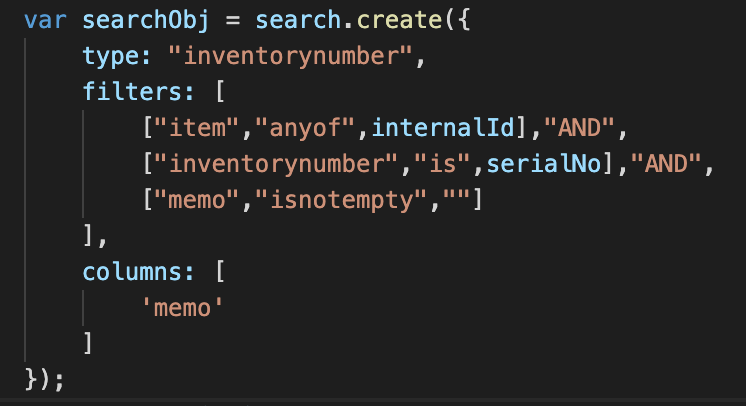
Surface a results of related Serial Number Records as a sublist on the Serialized Item Form. This was done by creating a Saved Inventory Numbers Search and adding it to the inventory part form as a custom sublist. This served as a nice view and the Edit link on each record becomes the software upgrade technician's entry point to attach the Memo. (This example utilizes the native memo field, a custom Item Number Field may also be used instead.)
Identify at what point the system would become aware of the specific serial number to be fulfilled. A Serial Number may be defined on the Sales Order or downstream in the warehouse using the Item Fulfillment transaction. In this case using the Item Fulfillment was standard practice.
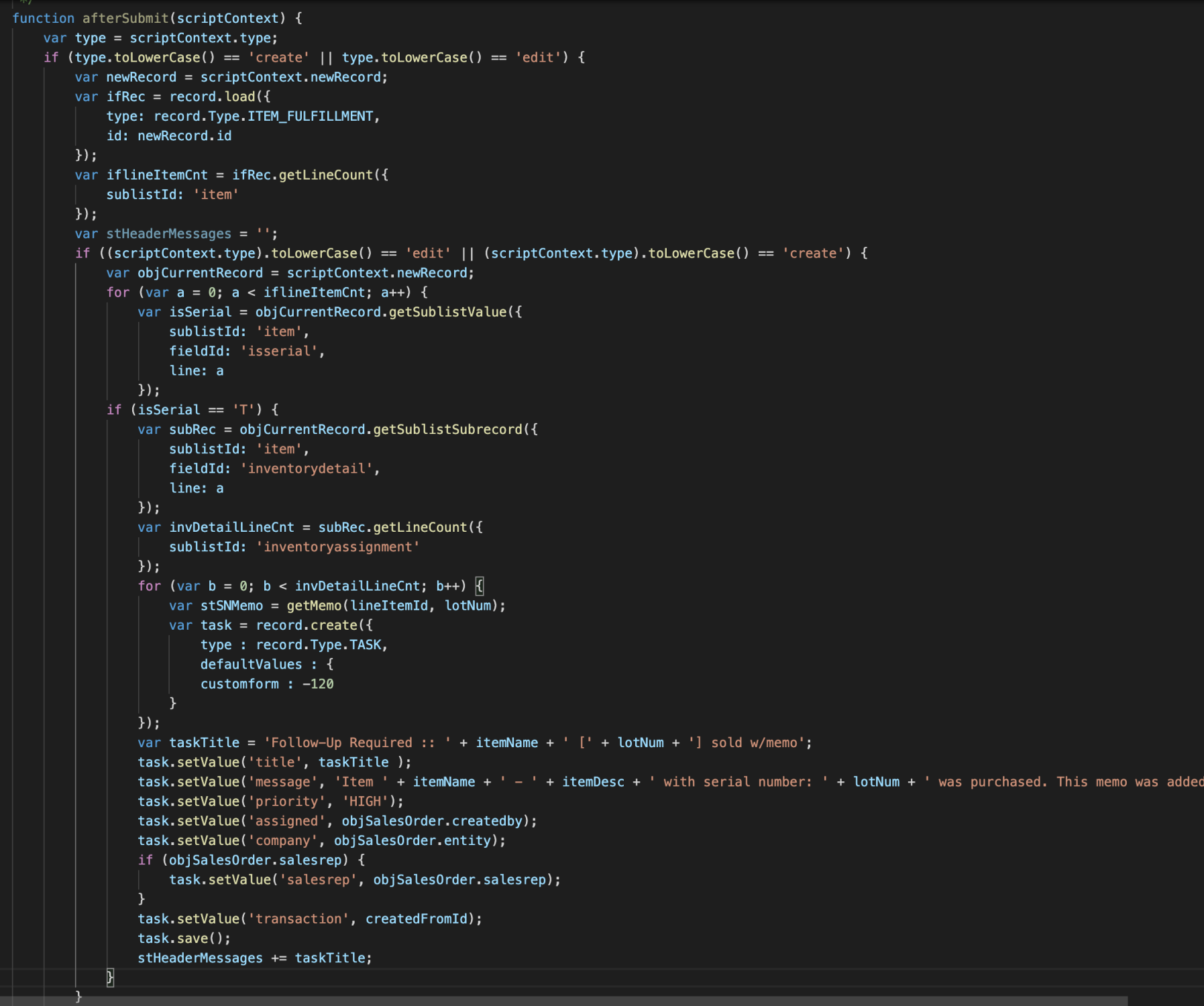
Now that the inputs are defined, logic is be built to recognize when one of these special items has been queued for fulfillment. For this all we need is a few functions in a simple User Event Script. This snippet of the code is triggered server-side after the fulfillment team member submits the form. The code parses the Item Sublist of the transaction and if the item is found to be Serialized, it digs deeper to Inventory Assignment records and calls the getMemo() function. The getMemo function dynamically retrieves any messages to be communicated via an alert ( Native NetSuite Task & Subsequent Email ) to the user who entered the Sales Order and displays an elegant red banner across the screen immediately on save for the Fulfillment Team Member who may have just picked the Enhanced Serialized Stock Unit off the shelf among many others.
In order to fire the Message API to instantly notify the Fulfillment Team Member of the note, don't forget to use the addPageInitMessage() function.
NetSuite gives you all the tools necessary to leverage your software investment to realize process efficiencies for your team and overall business. Should you find a need to engage with a firm that understands business process optimization, don't hesitate to reach out.
...
Make a Deposit in NetSuite to record funds you deposit into your bank account. Record Customer payments in the Undeposited Funds bank account. Use deposits to move funds from your undeposited funds bank account to your GL bank account when payments are physically deposited into the bank. This allows you to keep your GL bank account balance and the Actual bank account in sync.
Most teams eventually look at Unit of Measure in NetSuite and think they are missing something. The system supports it, it looks more structured, and it feels like the "right" way to do it.
In practice, expanding Unit of Measure often shifts complexity into every transaction instead of removing it. What looks like precision at the system level can quietly introduce friction across order entry, warehouse execution, and financial reporting.
I spent part of this weekend building my first AI agent from the ground up. Not because AI is the latest hype cycle, but because understanding where a technology might actually add value requires hands-on work. Across a career spanning finance, operations, and software, one thing hasn’t changed. Technology moves fast, but real value takes time to surface.